

Description
TB-500 10mg Research Peptide
TB-500 is a synthetic peptide material associated with research into thymosin beta-4-related cellular mechanisms, particularly processes involving actin regulation, cell movement, and tissue-associated biology. Its sequence relationship to thymosin beta-4 has made it a subject of investigation across several experimental models.
This TB-500 10mg presentation supplies a defined amount of peptide material in a laboratory vial. It can be catalogued as an individual research compound alongside its corresponding lot information, analytical records, and storage requirements.
Research use only. Not for human or veterinary use.
TB-500 at a Glance
| Product specification | Details |
| Compound | TB-500 |
| Presentation | 10mg |
| Material class | Synthetic peptide |
| Related peptide | Thymosin beta-4 |
| Research interest | Cellular migration and peptide signaling |
| Research areas | Actin-associated processes, cell movement, tissue biology |
| Format | 10mg vial |
| Intended use | Laboratory research |
Molecular Background
Thymosin beta-4 is a naturally occurring peptide involved in biological processes associated with the regulation of actin, an important structural protein within cells. TB-500 is a synthetic research material related to this peptide and is therefore of interest to researchers examining cellular movement and structural signaling.
The connection to actin-related biology provides a useful starting point for experimental investigations into how peptide sequences may participate in cellular organization, migration, and related molecular events.
TB-500 research should be distinguished from research involving full-length thymosin beta-4, as the materials are not interchangeable simply because of their relationship.
Research Areas
Studies involving TB-500 can cover several aspects of cellular and molecular biology.
Areas of investigation include:
Cell migration
Research into the molecular processes that allow cells to move through biological environments.
Actin-related mechanisms
Investigation of pathways involving actin organization and cellular structure.
Peptide signaling
Examination of how synthetic peptide materials interact with cellular signaling systems.
Tissue-associated biology
Experimental work examining molecular processes involved in cellular responses within tissue models.
Structure-function research
Comparative studies examining how peptide structure relates to observed biological activity.
Research outcomes depend on the experimental model and methodology used, so findings should be evaluated within their specific scientific context.
10mg Material Format
The TB-500 10mg vial provides a clearly identified quantity for laboratory inventory. A defined presentation can be useful when researchers are maintaining several synthetic peptides and need to distinguish each material by compound name, quantity, and lot.
The 10mg specification refers to the quantity supplied. It does not establish a recommended experimental concentration, dose, or administration protocol.
For research records, the material can be identified as TB-500, 10mg, with supporting documentation retained alongside the compound.
Research Documentation
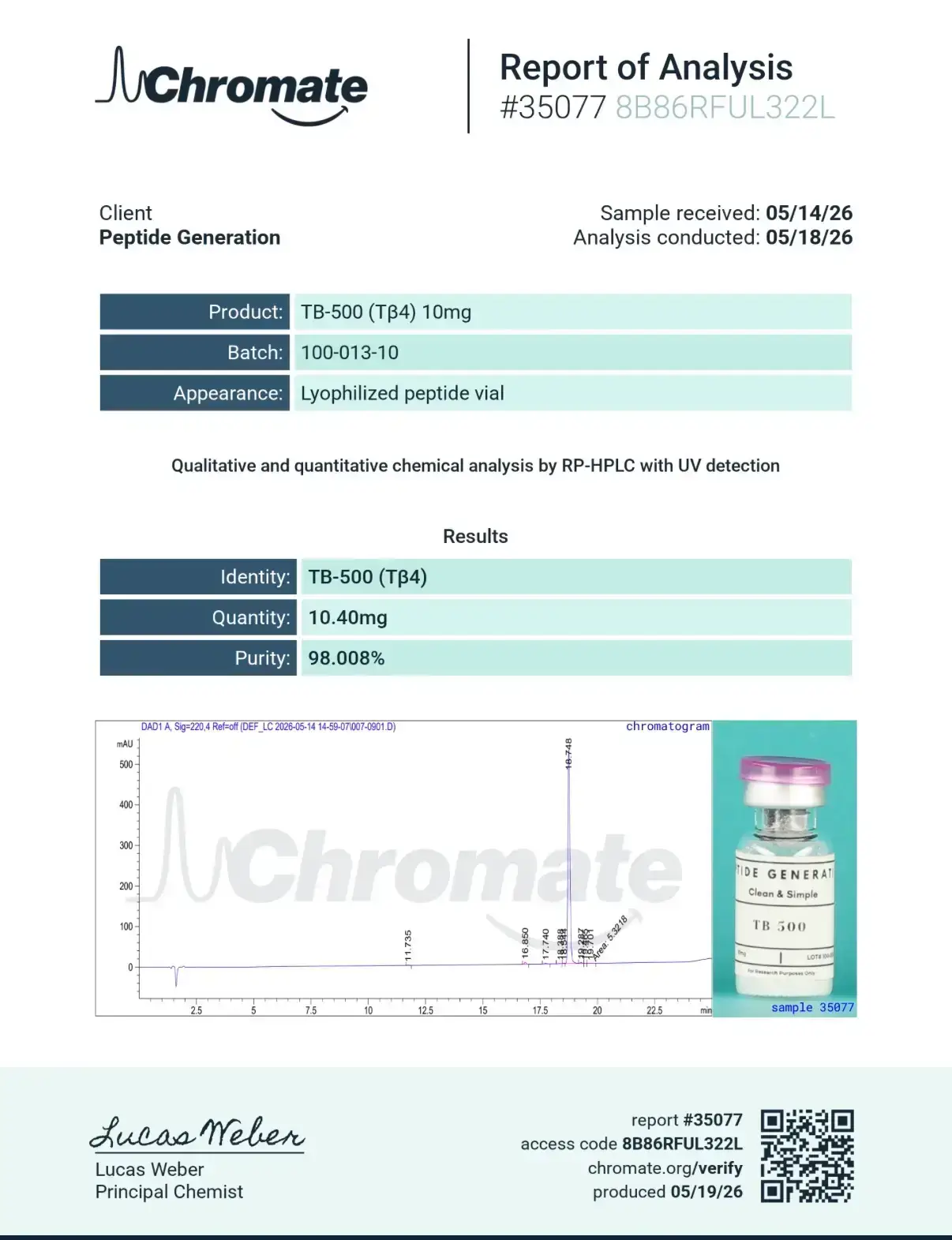
Before incorporating a TB-500 10mg research peptide into an experimental workflow, laboratories may review the available documentation associated with the specific material.
Useful records can include:
| Information | Laboratory purpose |
| Compound identity | Confirms the research material |
| Quantity | Establishes the 10mg presentation |
| Lot number | Supports batch traceability |
| Analytical results | Provides available characterization data |
| Storage conditions | Guides material handling |
| Research designation | Defines intended laboratory use |
Maintaining these details helps researchers connect the physical vial with the documentation associated with the relevant research material.
TB-500 and Cellular Research
One of the more interesting aspects of TB-500 research is its connection with biological processes involving cell movement and cytoskeletal organization. Cellular migration is a complex process requiring coordinated changes in cell structure, adhesion, and signaling.
Because TB-500 is associated with thymosin beta-4-related research, it provides a defined peptide material for investigating these mechanisms in controlled laboratory systems.
Researchers can therefore evaluate TB-500 alongside other peptide materials when studying cellular signaling, migration, and structural processes.
Product Handling
The TB-500 10mg compound should be maintained according to the storage and handling information supplied with the specific product. Laboratories should keep the vial appropriately identified and preserve relevant batch documentation as part of their normal research-material management procedures.
Storage requirements may vary according to formulation and supplier specifications, so researchers should refer to the product documentation rather than assuming conditions based solely on the peptide name.
Frequently Asked Questions
What is TB-500?
TB-500 is a synthetic peptide research material related to thymosin beta-4 and studied in experimental work involving cellular movement, actin-associated processes, and peptide signaling.
How much TB-500 is supplied?
This presentation contains 10mg of TB-500 research material in a vial.
What is TB-500 researched for?
Research interest includes cell migration, actin-related cellular mechanisms, peptide signaling, tissue-associated biology, and structure-function studies.
Is TB-500 the same as thymosin beta-4?
No. TB-500 is a synthetic research material associated with thymosin beta-4, but the two should not be treated as identical compounds simply because they are related.
What should researchers look for in TB-500 documentation?
Compound identity, quantity, lot information, available analytical data, storage requirements, and the stated research-use designation are useful information to review.
Is TB-500 10mg intended for human or veterinary use?
No. This material is supplied strictly for laboratory research and is not intended for human or veterinary use.
Research use only. Not for human or veterinary use.



Reviews
There are no reviews yet.